The site before the sails
Bennelong Point: the site's story
The history of Bennelong Point, known as Tubowgule, before the Sydney Opera House: its names, Woollarawarre Bennelong, Fort Macquarie and an earlier theatre.
Reserve your seats at the Opera House ↗Quick answer
The Sydney Opera House stands on Bennelong Point, which the Opera House's own history calls Tubowgule, a point that was a place for ceremony, gathering and celebration in Aboriginal Australia. After 1788 it was used for cattle and lime-burning, then for Fort Macquarie and a tram shed. Its present name honours Woollarawarre Bennelong.
Tubowgule
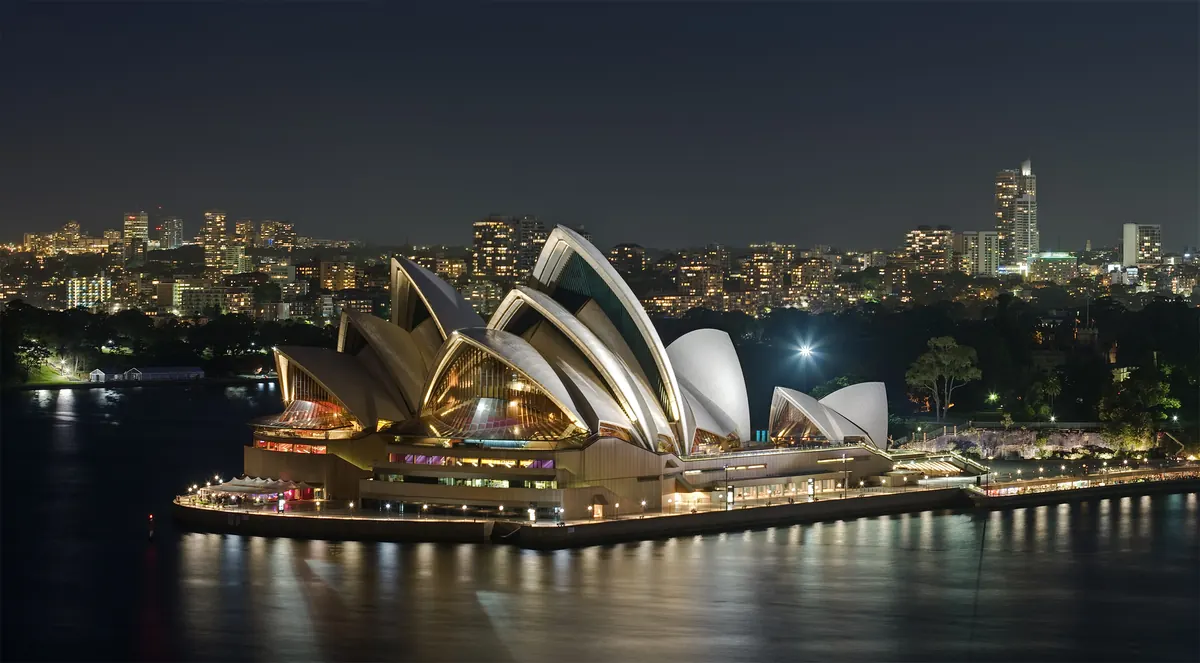
Tubowgule was a point at the end of a long, wide ridge, surrounded by rocky shoals that mostly covered at high tide. With its proximity to the harbour, cove, a freshwater creek and mud flats, the area was rich in resources, including oysters, mussels, fish, possums, wallabies, kangaroos and many edible plants. Shells and animal bones discarded by the Aboriginal people formed middens around Sydney Harbour. The Opera House says Tubowgule has always reflected the society tucked in around Sydney Cove.
Other names for the point
The British who arrived in 1788 used Tubowgule to confine their cattle and horses and renamed it Cattle Point. They crushed middens from around the harbour to make lime, and the promontory became known as Limeburners' Point. English Wikipedia gives Dubbagullee as the name known to the local Gadigal people of the Eora nation, and describes the point as a headland and former island on the shores of Sydney Harbour.
Woollarawarre Bennelong
The present name honours Woollarawarre Bennelong, a member of the Wangal people at the time of the colonists' arrival. The Opera House says Bennelong was kidnapped by the first Governor of New South Wales, Arthur Phillip, and served as an interlocutor between the Eora and the British. Phillip built a brick hut for Bennelong at his request. Bennelong became one of the first Aboriginal people to travel to London, where he attended the theatre at Covent Garden and the Houses of Parliament. He returned to Sydney and lived afterwards at Kissing Point.
Fort Macquarie
The Opera House says Governor Lachlan Macquarie ordered a fort to be built on Bennelong Point. Fort Macquarie was a square construction with circular bastions at each corner and a castellated square tower. The channel that separated the tidal island from the mainland at high tide was filled with rocks. The fort was later demolished and replaced by a tram shed, and English Wikipedia notes that before the Opera House was built Bennelong Point had housed a tram depot.
An earlier theatre
The Opera House says a precursor to the Opera House, a theatre for comic opera and vaudeville, opened in a warehouse in the 19th century and was later condemned. It adds that the idea of a dedicated performing arts centre in Sydney had been discussed for decades, and that Bennelong Point was declared the site for the proposed new opera house in the mid-1950s, before the international competition.
What the excavations show
The Opera House says this history is revealed through excavations on site. Archaeologists have uncovered seawalls, retaining walls, cuts, pick marks and drill marks, which are evidence of how this rocky outcrop has been shaped to meet the changing needs of the people who inhabit Sydney Cove. English Wikipedia adds that the original tidal island and its rubble fill were largely forgotten until both were rediscovered during the excavations for the Opera House.
Who this isn't for
This guide does not suit anyone looking for a full history of Aboriginal Sydney, which is far larger than one headland. It follows what the Opera House and English Wikipedia say about this one point, and the Opera House notes that its own history is still being revealed by excavation. Names and spellings differ between sources, so both are given above. For the building that now stands on it, read the guide to Utzon and the Opera House.
Read next: Utzon and the Sydney Opera House
Frequently asked questions
What is Tubowgule?
The name the Opera House gives to the point before it was called Bennelong Point.
Who was Bennelong?
Woollarawarre Bennelong, a member of the Wangal people, after whom the point is named.
What stood here before the Opera House?
Fort Macquarie, and later a tram shed.
When was the site chosen?
The Opera House says Bennelong Point was declared the site for the new opera house in the mid-1950s.
Sources